From the Archives: What Kunal Shah Said Before Anyone Was Paying Attention
A throwback to Building It Up with Bertelsmann. Years before leading WhatsApp globally, Kunal Shah shared insights on trust, conviction, markets, category creation and human behaviour that feel remarkably relevant today.
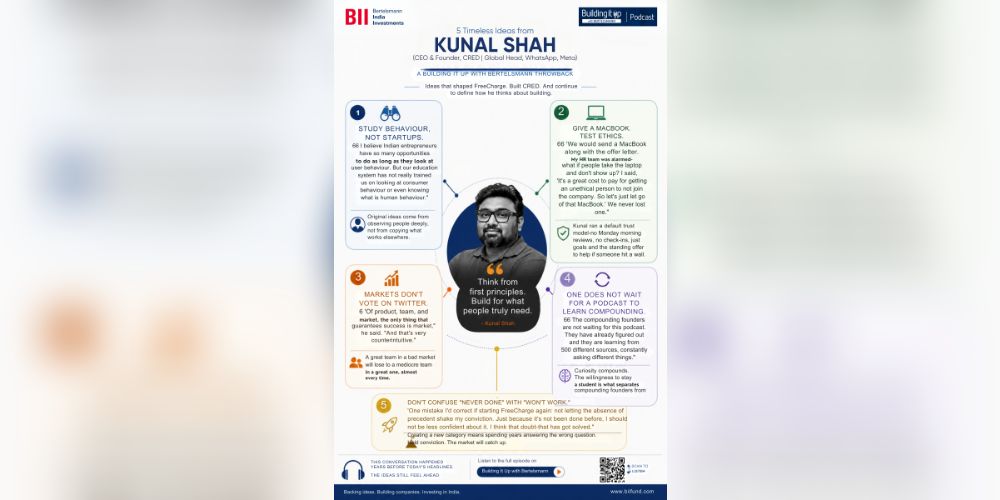
A throwback to Building It Up with Bertelsmann - revisited because some conversations age better than expected.
Years before the WhatsApp appointment. Years before CRED's first profitable quarter. Years before the critics went quiet. Kunal Shah sat down with us on Building It Up with Bertelsmann and said things that, at the time, sounded sharp but unverified.
Looking back now, they sound like a blueprint.
We're not revisiting this episode because Kunal Shah has had a big week. We're revisiting it because the ideas hold up and because the pattern they describe is exactly what his last decade proved. From FreeCharge to CRED to leading WhatsApp globally, the thinking has been remarkably consistent.
Here's what he said. Here's what it meant. Here's why it still matters.
Research Before Courage
The fail fast doctrine has been so thoroughly absorbed into startup culture that questioning it sounds almost contrarian. Kunal questioned it plainly.
"I think it's a very disastrous thing," he said. "Fail fast is a great strategy in a very high per capita market where your worst case outcomes are also decent. Over here, you can clearly get wiped out."
He described how he'd surveyed thousands of users before writing a single line of code for FreeCharge. Only when 95% of respondents confirmed they'd use the product did he build it. The first version- the one that scaled to 20,000 transactions a day was built by a developer in Noida for two lakh rupees.
This is the part that tends to get lost when people talk about FreeCharge as a success story. The mythology simplifies it to a good idea well executed. The reality was slower and more deliberate. Kunal was making a calculated bet, not a leap. He knew what Indian consumers would do long before he gave them anything to do it with.
The takeaway: A thesis held with conviction is only as good as the observation behind it. Research isn't caution. It's what gives courage its foundation.
Stop Copying. Start Watching.
"Indian entrepreneurs have so many opportunities to do as long as they look at user behaviour. But our education system has not really trained us on looking at consumer behaviour or even knowing what is human behaviour."
The default, he said, is to find what's working abroad, strip the context, transplant the model, and wonder why it fails. It fails because behaviour isn't geography. FreeCharge came from watching how Indians actually used their phones- constant low-cost recharges, high sensitivity to small incentives, low tolerance for friction. Nobody had studied that carefully enough to build for it. Kunal had.
The same method ran CRED. The insight wasn't that wealthy Indians needed a credit card payment app. It was that this cohort- high-trust, high-spend, ignored by products designed for scale would respond to something built specifically for them.
The takeaway: The original ideas are usually hiding in behaviour everyone sees and nobody examines.
Give MacBook. Test Ethics.
FreeCharge would send new hires a MacBook along with their offer letter before they joined. His HR team was alarmed. What if people walk off with the laptop?
"It's a great cost to pay for getting an unethical person to not join the company. So let's just let go of that MacBook."
They never lost one. What they gained was harder to manufacture: employees who felt trusted before they'd earned it, and responded accordingly. Several were working evenings in the office before their official start date not because anyone asked. The MacBook was a test. The people who passed it became, in his words, "a very different kind of monsters."
The takeaway: Trust given early is returned at scale. What looks like a risk is often just an investment in the kind of team you want.
No Reviews. Just Goals.
Connected to the MacBook story was a broader operating philosophy he called "default trust."
No Monday morning reviews. No weekly check-ins. He gave people a goal, a timeline, and an open door: come to me if you hit a wall. That was the entire management structure.
Review culture, he argued, optimises for the appearance of accountability rather than actual output. It treats people as variables to monitor rather than individuals to trust. The result is exactly what you'd expect: teams that manage upward rather than move forward. Reversing that- starting from a surplus of trust rather than a deficit didn't eliminate accountability. It made accountability unnecessary to surveil.
The takeaway: The cost of excessive reviews isn't the time they take. It's the talent they teach to play it safe.
Markets Don't Vote on Twitter
After FreeCharge was acquired, Kunal spent time at Y Combinator as a part-time partner. The gap he observed between early-stage founders in the US and India stayed with him.
"Of product, team, and market, the only thing that guarantees success is market. And that's very counterintuitive."
He'd noticed a pattern in polls: when founders were asked which of the three mattered most, "team" won. He found this predictable. Markets can't vote on Twitter. So naturally the poll tells you something about who's on Twitter, not about what actually drives outcomes.
The uncomfortable version: a great team in the wrong market will lose to an average team in the right one, almost every time. CRED entered the credit card repayment space when creditworthy Indians were widely ignored as a consumer segment- too small to chase at scale, too valuable to overlook if you looked carefully. That wasn't an accident. It was a thesis built on reading the market rather than the consensus.
The takeaway: Where you build matters more than how good you are at building. Find the fertile ground first.
Compounding Founders Don't Wait for Podcasts
"The compounding founders are not waiting for this podcast. They have already figured out and they are learning from 500 different sources constantly asking different things."
He described a specific moment from his FreeCharge years: the company had granular visibility into how Indians consumed mobile data. He waited to see which founders would call and ask about it. None did. The information wasn't hidden. It wasn't proprietary. It just required the curiosity to ask someone you didn't already know.
Compounding curiosity, in his framing, isn't about reading more. It's about the willingness to feel uninformed in front of someone who might know something you don't. That's a quieter, less visible kind of confidence and considerably harder to fake.
The takeaway: The gap between compounding and non-compounding founders widens slowly, then suddenly. Curiosity is the variable.
Conviction Looks Like Stubbornness Until It Doesn't
One regret he mentioned about FreeCharge: he sometimes let the absence of precedent shake his confidence. Why hasn't anyone built this? Am I missing something?
When you're creating a category, you spend years answering the wrong questions. Investors ask which global bucket you fit in. Journalists compare you to something you don't resemble. CRED went through a long public stretch of scepticism- the "startup for the rich" critique was never entirely wrong, it just missed what was being built toward. The first profitable quarter arrived when the underlying behaviour had always been there.
The WhatsApp appointment is another version of the same pattern: a bet on someone who has demonstrated, repeatedly, that he'll hold an uncomfortable position until the market catches up.
The takeaway: The hardest categories are the ones people don't know how to describe yet. If you've done the research, the absence of a name isn't a warning sign.
Looking back at this conversation, what strikes us is how little of it required foresight. It mostly required honesty- saying things that were unfashionable: that most founders want to be called founders more than they want to build; that exits aren't defeats; that copying a model without studying behaviour is just optimism with extra steps.
India's startup ecosystem has matured since that episode. And yet the tensions Kunal named - imitation over observation, narrative over market, insecurity dressed as ambition haven't gone anywhere.
Kunal's appointment to lead WhatsApp is a significant milestone. But revisiting this conversation, what stands out isn't the title.
It's the consistency.
Across FreeCharge, CRED and now WhatsApp, the underlying principles remain remarkably similar: study behaviour deeply, build with conviction, question accepted wisdom and stay patient while others look for immediate validation.
Companies, markets and roles change. The method endures.
SIGN UP FOR BLOG UPDATES
Related Post
WRITE FOR US
Join our community of guest bloggers today!
Stay informed. Stay inspired.
Sign up for our newsletter to get information on the latest venture capital insights and breakthroughs in the start-up world.
Post a Comment