Mythbusters: Has the SaaS bubble burst?
The SaaS industry has been compared to the dot-com bubble burst- what with the string of tech layoffs and the general atmosphere of uncertainty in the space, it’s not difficult to see why many people may think that SaaS’s time is past.
TLDR
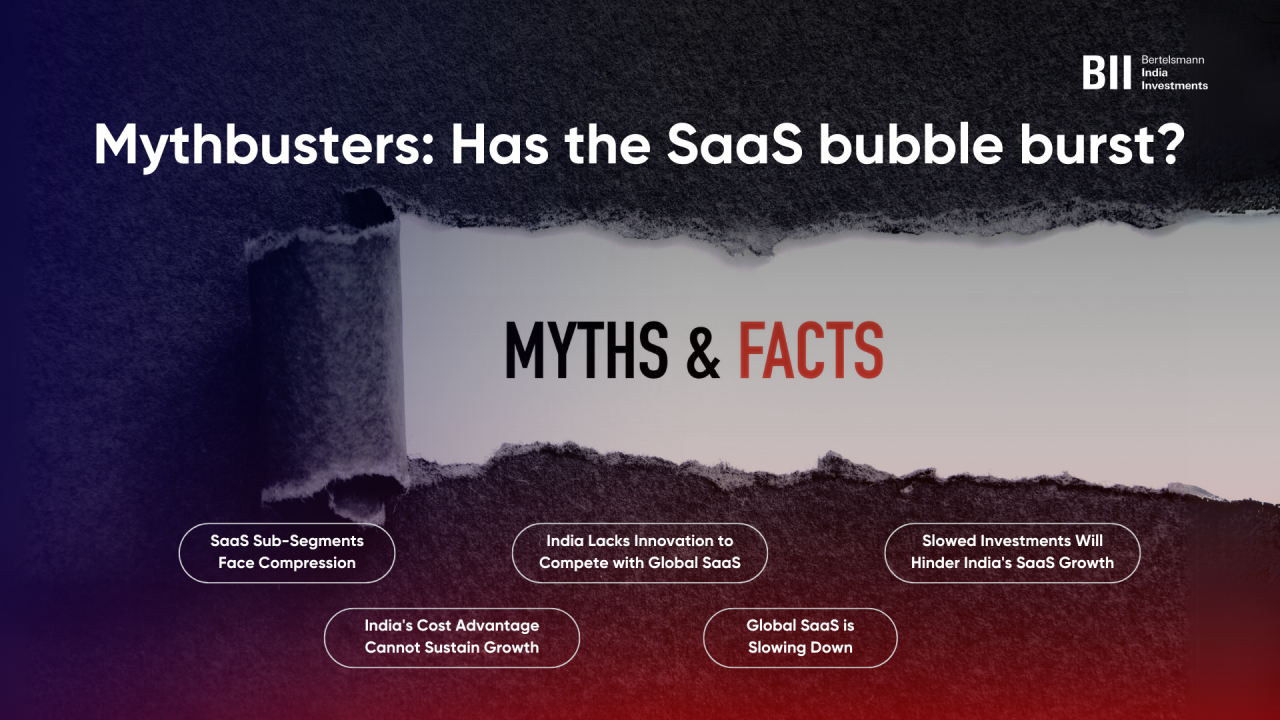
Bertelsmann India Investments (BII) Mythbusters- Has the SaaS Bubble Burst? The Data Says Otherwise.
- The SaaS industry has been likened to the dot-com crash. Those trends have been exacerbated by shrinking valuations, layoffs by tech firms, and an overall uncertainty.
- The global SaaS market surged by $420 billion between 2020 and 2022, surpassing projections by 150%. Despite a projected slowdown in broader enterprise tech, SaaS is expected to maintain a 16–18% annual growth rate, potentially reaching $1.3–1.6 trillion by 2030. Software and SaaS contribute only 25% to revenue but drive 48% of total enterprise technology value. This is not a bubble deflating; it is a market maturing.
- For India specifically, the story is even more compelling. While global SaaS investments dipped 20% in 2022, Indian SaaS investments grew 24% in the same period.
- India's cost advantage is not cyclical but structural. SaaS companies here spend 15-20% less on sales and marketing, and 30-40% less on R&D than their global counterparts. The trend of using AI in tools is not limited to BII; a significant 46% of Indian developers are already integrating AI into their tools, with many, such as SquadStack and Awign, using it to streamline processes and enhance user experiences.
- It is an example of Bertelsmann India Investments' sector-agnostic, conviction-driven approach to early growth stage investing. The recent slowdown in Saas investment is not a cap on it; it's rebalancing. BII is thrilled to support founders creating the next chapter of the SaaS story in India.
The SaaS industry has been compared to the dot-com bubble burst- what with the string of tech layoffs and the general atmosphere of uncertainty in the space, it’s not difficult to see why many people may think that SaaS’s time is past.
This article, part of BII’s Mythbusters series, attempts to determine how much fact- or fiction- is contained in these opinions.
The Situation At Hand
The global SaaS market has defied expectations, surging by an astonishing $420 billion from 2020 to 2022, surpassing projections by a whopping 150;dj. What's driving this explosive growth?
Despite projections of a slowdown in overall enterprise tech growth, SaaS is anticipated to maintain a robust annual growth rate of 16–18;dj. By 2030, it could reach an astounding $1.3–1.6 trillion.
The catalysts behind this trajectory include-
- The accelerated digitization during the pandemic
- Widespread adoption of public cloud by small and medium-sized businesses (SMBs)
- The growing standardization of services to the SaaS model.
Simply put, SaaS businesses were forced to adapt- first to the pandemic and then to the subsequent cloud services ad service by almost every business.
Myth 1: The Global SaaS Market is Slowing Down
While global SaaS investments experienced a 20;dj decrease in 2022, this slowdown doesn't necessarily translate to a market bubble burst. The Indian SaaS market, in contrast, witnessed a surge in investments by 24;dj, demonstrating its robustness and attractiveness to global investors. Furthermore, software and SaaS contribute only 25;dj to revenue but drive 48;dj of total enterprise technology value. Additionally, system infrastructure and development tools are expected to see overall SaaS penetration grow from ~50;dj in 2022 to ~75;dj in 2030.
Myth 2: All SaaS Sub-Segments Are Facing Compression
Despite an overall compression in valuations, certain sub-segments of the SaaS market have shown resilience. Education and AI platforms, for instance, exhibited lower compression than other segments, indicating their potential for growth and investor confidence. Key growth subsegments within horizontal applications include Analytics and BI (31;dj CAGR), AI platforms (40;dj CAGR), and Supply Chain management systems, which are growing at twice the annual growth rate of the top four most-penetrated segments. CRM and collaborative applications are expected to have the highest penetration levels at >80;dj.
Myth 3: India's Cost Advantage Is Not Enough to Sustain Growth
India's cost advantage is not merely a temporary benefit but a structural one. SaaS companies in India enjoy-
- 15-20;dj lower sales/marketing investment,
- 30-40;dj lower R&D intensity,
- Superior payback periods compared to their global counterparts.
The Indian SaaS ecosystem operates on a solid foundation of sustainable advantages. For example, the Indian SaaS ecosystem has grown from $2.6 billion in 2020 to $7 billion in 2022, fueled by a 3x increase in the number of new SaaS companies founded. The Indian domestic opportunity stands to be the fastest-growing market at a projected SaaS CAGR of 32;dj between 2020-2025.
Myth 4: India Lacks the Innovation to Compete in the Global SaaS Market
India is emerging as a leading hub for AI adoption among software developers, providing fertile ground for innovative SaaS solutions. BII portfolio companies like SquadStack and Awign are leveraging AI to automate tasks, personalize experiences, and gain a competitive edge, proving that they are cost-effective and innovative. Additionally, 46;dj of Indian developers already incorporate AI into their tools, and 84;dj have plans to integrate AI into their development process. Furthermore, 55;dj of Indian developers express trust in AI-generated output, and India has emerged as a leading hub for open-source AI projects on GitHub.
Myth 5: The Investment Slowdown Will Hinder India's SaaS Growth
While the recent investment slowdown poses a challenge to the Indian SaaS market, it's important to note that the market is still in its early stages of growth. The slowdown allows companies to focus on product development, customer acquisition, and building a strong foundation for long-term growth. Within the next decade, India’s SaaS revolution stands to generate $50-70 billion in revenue and more than half a trillion in value creation, likely nurturing 100+ unicorns and 50 centaurs ($100 million+ ARR companies) and creating over 500,000 jobs.
The Indian SaaS market has not slowed down but merely stabilized. It is now positioned for a strategic phase of development. The recent investment slowdown, far from hindering growth, presents an opportunity for Indian SaaS companies to recalibrate their strategies and fortify their positions in the global market.
SIGN UP FOR BLOG UPDATES
Related Post

WRITE FOR US
Join our community of guest bloggers today!
Stay informed. Stay inspired.
Sign up for our newsletter to get information on the latest venture capital insights and breakthroughs in the start-up world.
Post a Comment